

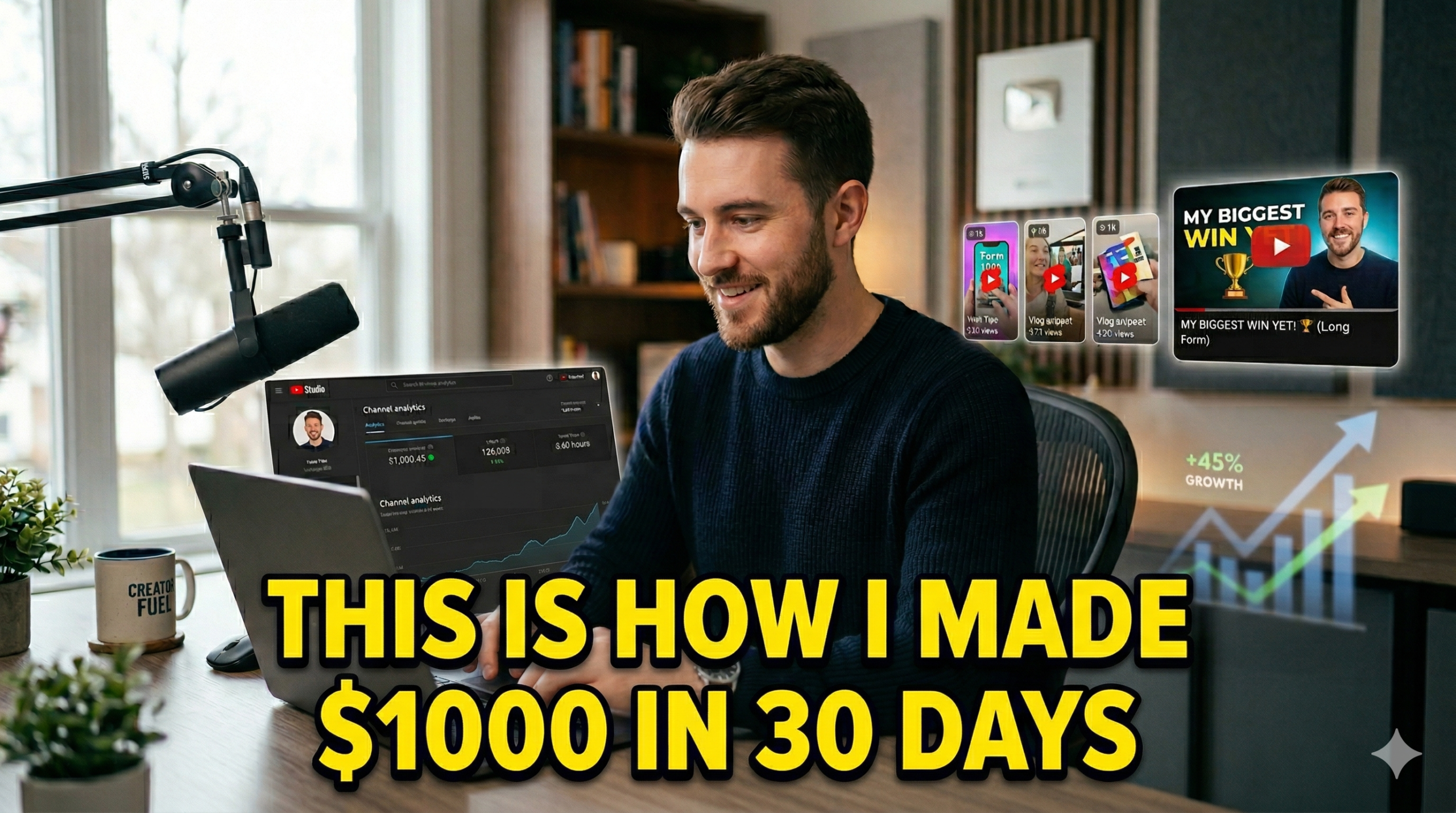
How to make $1000 on YouTube in 30 days is not about luck or going viral, I found myself staring at my YouTube Creator Studio, feeling incredibly frustrated. I was putting in hours of effort—writing, filming, and editing late into the night—but my channel felt like a leaky bucket. I would get a burst of views one day, and absolute crickets the next. That’s when I made a firm decision: no more random uploads. No more guessing what the algorithm wanted.
I stopped treating my YouTube channel like a weekend hobby and finally started treating it like a measurable, predictable business system.
Fast forward 30 days, and I crossed my first $1,000 in YouTube revenue.
I didn’t buy an expensive camera setup; I used what I had. I don’t have a team of researchers or a custom thumbnail designer. And I definitely don’t have crazy, MrBeast-level editing skills with 3D animations and explosions.
But here’s the truth most people—especially the “gurus” trying to sell you $500 masterclasses—won’t tell you: This wasn’t luck. It wasn’t a random viral accident. It was a highly structured, repeatable strategy that aligns perfectly with how YouTube actually works in 2026.
Here is exactly how I did it, the data behind the strategy, and how you can replicate it step-by-step.

My Starting Point (No Fake Guru Story Here)
Let’s be completely transparent. I wasn’t starting from absolute zero. I had some experience creating content—I knew how to cut a video together and add basic text. I also had a small handful of subscribers from random videos I had posted over the years.
But my income? It was practically non-existent.
I was stuck in a cycle most creators know too well: spending 10 hours on a video only for it to get 42 views, while a blurry, 5-second clip I posted as a joke got 5,000. There was zero consistency, no overarching system, and absolutely no focus on actual monetization. I was just throwing spaghetti at the wall and hoping something would stick.
That lack of direction is exactly what I had to fix.
The Mindset Shift That Changed Everything
The biggest turning point happened when I stopped asking myself one toxic, time-wasting question: “Will this video go viral?”
Chasing virality is exhausting and largely out of your control. Even worse, viral videos often attract the wrong audience—people who subscribe for one funny moment but never watch your other content.
Instead, I started asking a much better, business-focused question: “How does this video fit into a system that makes me money?”
That’s when I discovered a critical truth about content creation today. YouTube in 2026 is no longer just about going viral. It’s about building a funnel. A funnel is a marketing term that essentially means guiding a stranger on a journey: from first discovering you, to trusting you, to eventually generating revenue (either through ads, sponsorships, or products).

The Hybrid System: The Shorts-to-Long-Form Funnel
To make this funnel work, I divided my channel into two distinct engines. They work together, but they serve entirely different purposes. Here is the exact structure I used:
1. The Traffic Engine (YouTube Shorts)
Shorts became my “top-of-funnel” strategy. I committed to posting 20-to-30-second vertical videos. These needed to be fast-paced, straight to the point, and heavily optimized for audience retention. My only goal here was to reach non-subscribers and introduce them to my brand.
How to execute this: I focused entirely on the first 3 seconds (the hook). If you don’t grab them immediately with a bold statement or visual change, they scroll.
Why this works: The YouTube algorithm aggressively pushes Shorts to new, untested audiences on the Shorts feed. Even as a completely unknown creator, you have the potential to reach thousands, hundreds of thousands, or even millions of eyeballs overnight.
The Catch: Shorts don’t pay well. At all. Because ads are only shown between Shorts in the feed, the revenue is split. You can get a million views and barely afford a nice dinner. That’s why you absolutely need the second engine.
2. The Money Engine (Long-Form Videos)
Once a week, I uploaded a 5-to-10-minute traditional YouTube video. I didn’t stress over coming up with entirely new, groundbreaking concepts; instead, I looked at my analytics. Whatever topic was performing best in my Shorts, I turned into a long-form video.
How to execute this: If I had a 30-second Short about “3 Ways to Save Money,” my long-form video would be a detailed, 8-minute tutorial breaking down exactly how to implement those 3 ways, complete with examples.
Why this works: Long-form videos have drastically higher revenue per 1,000 views (RPM). Advertisers pay a premium to place ads before, during (mid-rolls), and after long videos because the audience is highly engaged. While Shorts generated the initial attention, my long-form content captured that attention, built trust, and converted it into real, ad-supported income.
3. Smart Content Reuse
I stopped trying to reinvent the wheel every single day. Operating alone means your time is your most valuable asset. If a Short performed incredibly well, I took that winning idea, expanded on it, improved the structure, and turned it into my weekly long-form video.
Alternatively, I would script my long-form video first, and then pull 3 or 4 highly engaging quotes from it to post as Shorts throughout the week. This “hub and spoke” model saved me dozens of hours of brainstorming and guaranteed I was making content my audience actually wanted to see.

Breaking Down the $1,000 (The Real Numbers)
It’s easy to claim you made $1,000 online, but I want to show you exactly where every dollar came from so you understand the mechanics. Here is the realistic breakdown of my 30-day sprint:
- Shorts Revenue: ~$500 – $600 (This required massive view counts—in the millions—due to the incredibly low RPM of short-form content).
- Long-Form Revenue: ~$300 – $400 (This required significantly fewer views—only a few tens of thousands—thanks to a much higher RPM).
- Additional Income: ~$50 – $100 (These were small secondary monetization streams, like early channel memberships and a few affiliate links placed in my video descriptions).
- Total: ~$1,000 in 30 days
The Reality Behind These Numbers (Understanding RPM)
This is where 90% of aspiring creators misunderstand YouTube economics. RPM stands for Revenue Per Mille (cost per 1,000 views).
Currently, a typical Shorts RPM hovers around $0.01 to $0.07 per 1,000 views. To earn $500 from Shorts, I needed millions of views.
However, a standard long-form RPM can range anywhere from $2 to $20+ per 1,000 views (depending on your niche; finance and tech pay higher than gaming or vlogs). To earn that $300 from my long-form videos, I only needed a fraction of the traffic.
This data confirms the core philosophy of the 2026 hybrid strategy: Shorts bring the attention. Long videos make the money.
| Content Category / Niche | Average Long-Form CPM (2026 Est.) | Advertiser Intent Profile |
| Personal Finance & Investing | $15.00 – $50.00+ | High intent, massive lifetime customer value (LTV). |
| Digital Marketing & SaaS | $12.00 – $18.00 | B2B purchasing power, recurring software subscriptions. |
| Technology & Product Reviews | $10.00 – $30.00 | Direct consumer purchasing intent, high affiliate overlap. |
| Education & E-Learning | $9.00 – $25.00 | Self-improvement, career advancement, course purchasing. |
| Gaming & Let’s Plays | $4.00 – $15.00 | Saturated market, younger demographic, lower disposable income. |
| General Entertainment / Comedy | $1.00 – $4.00 | Passive consumption, difficult to target specific consumer needs. |
| Geographic Market | Estimated Average CPM (USD, 2025-2026) | Market Profile |
| Australia | $13.30 – $36.21 | High disposable income, premium localized ad spend. |
| United States | $14.67 – $32.75 | Largest overall ad market, high competition. |
| United Kingdom | $8.91 – $24.00 | Strong European market, high e-commerce adoption. |
| India | $0.70 – $0.83 | Massive volume, low purchasing power parity. |
| Philippines | $0.48 – $1.12 | Emerging digital market, highly saturated short-form consumption. |
The Biggest Mistake Most Creators Make
When people see these numbers, they usually fall into what I call the “Shorts Trap.” They think, “More views equals more money,” so they abandon long-form entirely and only post Shorts.
Problem 1: The Shorts-Only Strategy If you only post Shorts, you are building a house on rented land. You will inevitably end up with millions of views but a bank account that reflects a part-time minimum wage job. Furthermore, Shorts viewers are notorious for not remembering the creators they watch. They swipe and forget.
Problem 2: The Disconnected Audience Some creators try to do both formats, but their Shorts have nothing to do with their long-form videos. For example, if you build an audience by posting funny, trending meme Shorts, those viewers are not going to click on your 10-minute long-form video about a serious topic like personal finance or tech reviews.
When your subscribers ignore your long videos, your Click-Through Rate (CTR) plummets. The algorithm sees this, assumes your video is bad, and actively stops pushing it. Your Shorts and your long-form videos must serve the exact same niche and target the exact same type of viewer.
What Actually Worked (And What Didn’t)
During this 30-day experiment, I took detailed notes on what actually moved the needle and what was a total waste of time.
The Winning Tactics ✅
- Consistency over Perfection: Uploading a “good enough” Short every single day mattered far more than spending a week perfecting one masterpiece. The algorithm rewards active channels.
- Ruthless Retention: I spent 80% of my editing time on the first 3 seconds of the video. I used a simple formula: Hook (give them a reason to stay) -> Retain (deliver the value quickly) -> Payoff (wrap it up without dragging it out). If the pacing was fast and there were no dead, boring “umms” or pauses, the video succeeded.
- Simple Editing: I learned that over-editing actually hurts. Viewers in 2026 crave authenticity. Crazy, hyper-stimulating edits with a million sound effects often feel like spammy advertisements and cause people to swipe away. Clean cuts and clear audio are all you need.
- System Thinking: Every video had a job. Shorts were the wide net to catch the audience; long-form videos were the filter to build a relationship and monetize them.
The Losing Tactics ❌
- Random Uploading: Posting on a Tuesday, disappearing for a week, and then posting three times on a Sunday resulted in dead engagement. No schedule means no momentum.
- Blind Trend Chasing: Jumping on a viral dance or a trending audio track might get you empty views, but if it doesn’t fit your specific niche, those viewers won’t stick around, and it won’t make you money.
- Lazy Reposting: You can’t just stitch three 20-second Shorts together, export it as a 1-minute video, and call it “long-form content.” You have to actually add value, deeper context, and personality.

The Final Takeaway: Can You Do This?
Here is the absolute biggest lesson I learned over the last month: You do not need millions of subscribers to make a full-time living on YouTube.
You don’t need to be famous. You just need a system, the right mix of content, and relentless consistency.
Can you do this? Yes. If you are willing to stay consistent for 30+ days, strictly follow the Shorts-to-Long funnel structure, and actually look at your analytics to see what’s working rather than trusting your ego.
Will you fail? Probably. You will fail if you expect instant results on day three, if you quit when your third video gets 0 views, or if you refuse to stick to a specific niche strategy because you want to “make videos about everything.”
My first $1,000 wasn’t a lucky break. Once you build a repeatable system, scaling from $1,000 to $5,000 becomes a matter of mathematics, not magic. You just put more refined input into the top of the funnel.
What You Should Do Next
If you want to try this and escape the cycle of frustration, start simple today. Don’t overcomplicate it.
- Commit to the Daily Short: Post one highly-retaining Short per day focused entirely on your specific niche.
- The Weekly Anchor: Upload one long-form video per week that expands on the best-performing topic from your Shorts.
- Change Your Mindset: Stop thinking like a hobbyist who makes videos for fun, and start treating your channel like a business that provides value to a specific audience.
The truth is, making your first $1,000 isn’t the hardest part of YouTube. Starting is. But once you start—and once you commit to staying consistent—absolutely everything changes.
Close this tab. Open your camera. Get to work.



Leave a Reply